
DNV, Lloyd's Register and ABS Approval for Cable Ties: Why It Matters and How to Check the Covered Part Numbers
DNV, Lloyd's Register and ABS Approval for Cable Ties: Why It Matters and How to Check the Covered Part Numbers
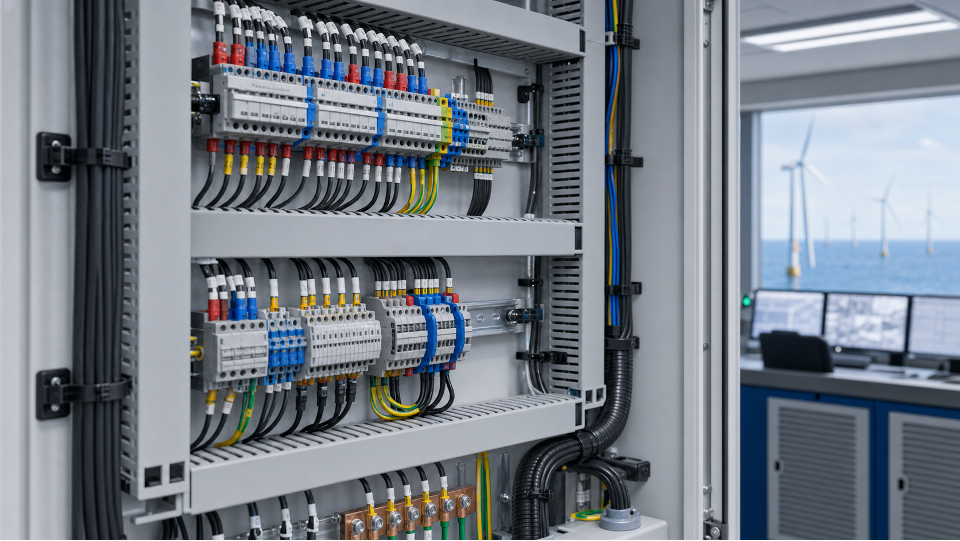
Offshore control equipment brings together product safety, environmental exposure and project approval requirements.
A familiar scene at marine and wind project audits: the bill of materials says "nylon cable tie, 300 mm", the supplier does provide a class society certificate, and then the owner turns to the coverage list and finds that the part numbers on the certificate do not match what was actually delivered. The material itself may be fine, but if the documents do not match, that item has to be submitted again, and the schedule and the budget have already taken the hit. This article explains the three class society approvals held by KSS cable ties: what each one is, which part numbers it covers, and how to check before submission.
1. Class society approval and UL, CSA or VDE do not verify the same thing
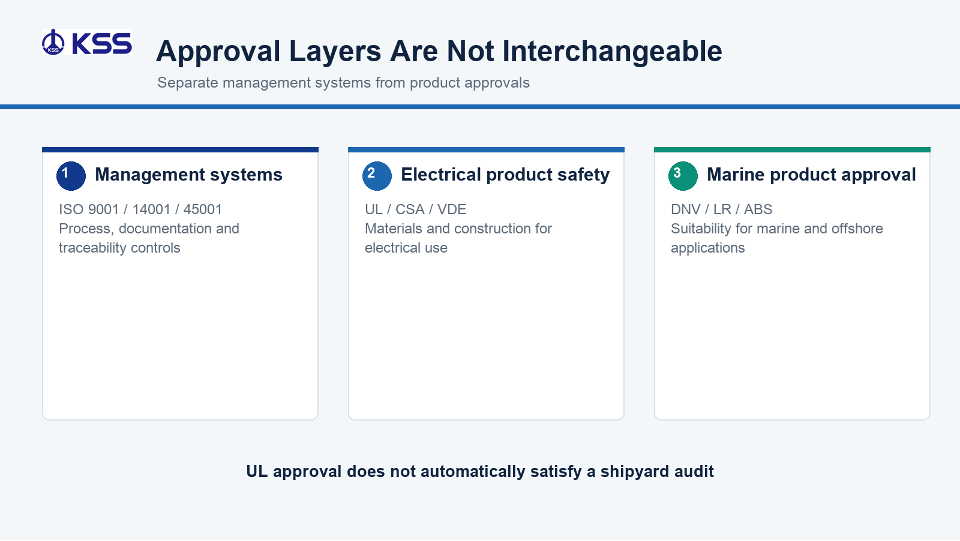
Class society approval, UL, CSA and VDE address different compliance questions.
Buyers often treat "certified" as a single status, but the approvals listed in the KSS master catalog fall into two distinct levels. Company management system certificates (ISO 9001, ISO 14001, ISO 45001, ISO 14064-1, IATF 16949 and ISO/IEC 17025) show that processes, documentation and traceability are under control. Third-party product certifications (UL, CSA, VDE, DNV, Lloyd's Register, ABS, CE, UKCA, RoHS and IP68) apply to the product itself.
Within that product level, UL, CSA and VDE are the electrical safety systems of their respective markets and look at the safety of the material and the design in general electrical use. The class societies, DNV, Lloyd's Register and ABS, grant product approval for ships and marine installations and assess whether the material is suitable under marine conditions and class rules. The two are not interchangeable: a part number with a UL Listing is not evidence for a shipyard audit, and the reverse is equally true.
2. The three class societies do not cover the same KSS part numbers
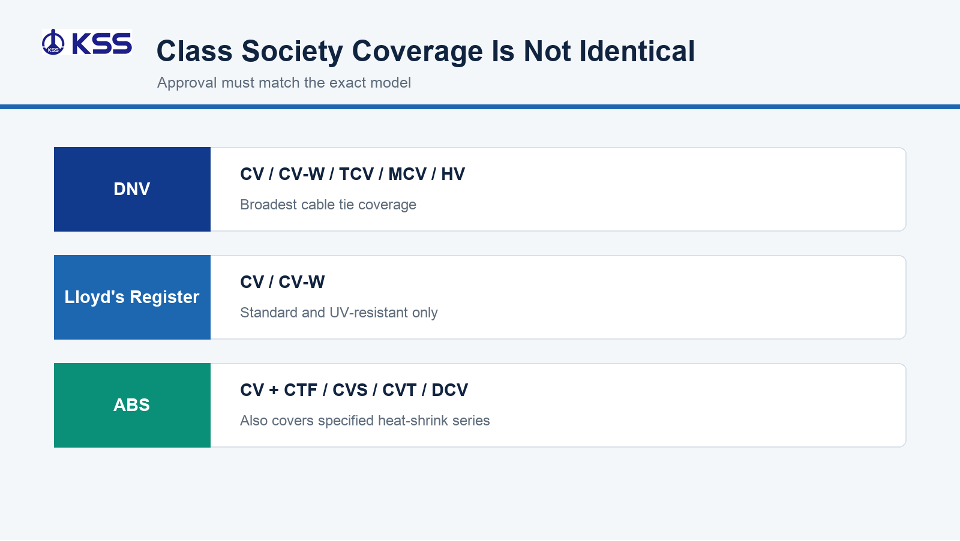
Approval scope differs by class society and must be checked against the exact part number.
This is the point most often missed, and the one most likely to cause a problem. The three bodies cover different parts of the KSS cable tie range:
|
Certification body |
KSS products covered |
What this means in practice |
|
DNV (Norway) |
CV, CV-W, TCV, MCV and HV series |
Standard, UV-resistant, screw-mount, marker and releasable ties are all covered, making DNV the broadest of the three |
|
Lloyd's Register (UK) |
CV and CV-W series |
Covers only the standard and UV-resistant ranges. If the drawing specifies LR, derivative types such as the TCV screw-mount tie or the HV releasable tie cannot be substituted |
|
American Bureau of Shipping (USA) |
CV series plus derivative types such as CTF, CVS, CVT and DCV; also covers MD, KD, HD, HVD and VD heat shrink tubing |
The only one of the three that also covers heat shrink tubing, so ABS is the first place to look if termination insulation has to be approved at the same time |
Coverage is compiled from the certification overview in the KSS master catalog (catalog P.251). Certification coverage varies by specific model and SKU; for a formal project, please confirm the applicable part numbers and certificates with our sales team.
3. What each covered product line actually is
The series codes in the table above correspond to five different cable tie formats. Decide on the format first, then check whether that format falls within the coverage of the class society your project requires:
|
Series |
Key specifications |
Class society coverage |
Catalog page |
|
CV / CVT (standard) |
UL recognised NYLON 66, 94V-2; roughly 60 sizes from 63.7 to 1,500 mm, widths 2.5 to 9.0 mm, tensile strength 7 to 462 lbs (3 to 210 kgs) |
Covered by DNV, LR and ABS |
P.64-65 |
|
CV-W (UV resistant) |
UL recognised NYLON 66 in UV-resistant compound, 94V-2; roughly 65 sizes from 63.7 to 1,500 mm, widths 2.4 to 9.0 mm |
Covered by DNV, LR and ABS |
P.72-73 |
|
TCV / TCVS (screw mount) |
Head with a screw hole for fixing to a base plate; lengths 110 to 400 mm, widths 2.5 to 7.9 mm, screw hole 3.2 to 6.0 mm |
Covered by DNV (not by LR) |
P.74 |
|
MCV (marker tie) |
Blank marker plate at the head for writing identification; lengths 100 to 370 mm, widths 2.5 to 4.8 mm, plate sizes 8 x 25 to 54.5 x 13 mm |
Covered by DNV (not by LR) |
P.78 |
|
HV (releasable) |
Can be released and reused; lengths 125 to 500 mm, widths 7.6 to 8.5 mm, tensile strength 50 to 75 lbs (22 to 34 kgs) |
Covered by DNV (not by LR) |
P.82 |
One practical point follows directly from this table. If the project specifies Lloyd's Register, only the standard CV and the UV-resistant CV-W are available. If the installation team decides on site to switch to the TCV screw-mount tie because the tie has to be fixed to a base plate, or to the releasable HV because maintenance access is needed, the part number falls outside LR coverage. These substitutions are usually made on site, and by the time the documentation stage arrives it is generally too late to correct them.
4. Where class society approval is required
• Shipbuilding and marine engineering: wiring for shipyards, offshore platforms and port equipment normally names a class society directly in the specification.
• Offshore wind: bundling in the nacelle, the tower and offshore substations. Because the conditions are close to those on a ship, owners usually apply the same class society requirements.
• Evidence of reliability for onshore projects: class society approval exists for ships and offshore equipment, but it also serves as evidence of material reliability onshore. If a control cabinet is ultimately shipped to a shipyard, an offshore platform or a wind farm, the covered part numbers for all three approvals must be checked one by one.
5. Three checks to make before submission
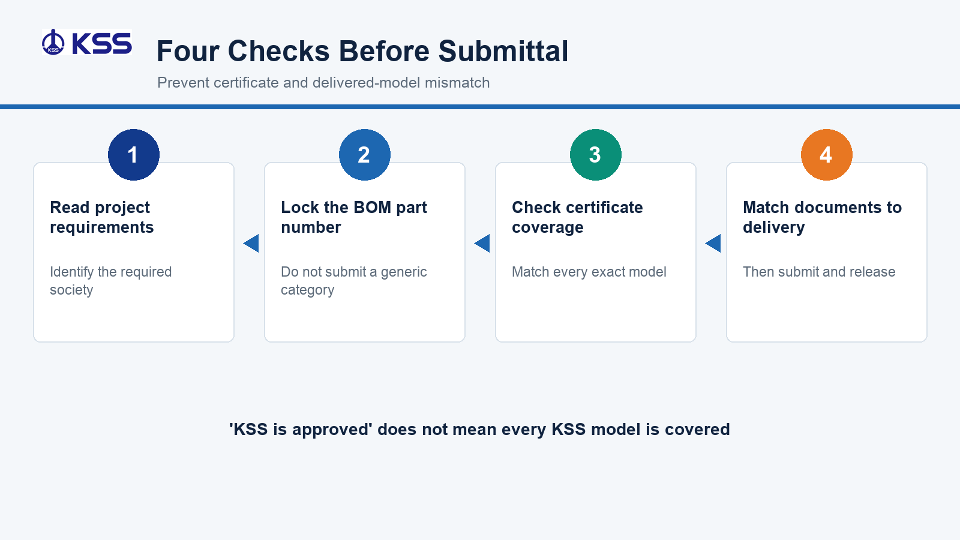
Confirm the society, exact part number and current certificate before project submission.
First, approval applies to part numbers, not to product categories. The statement "KSS holds DNV approval" is correct, but it does not follow that the specific KSS tie you bought is DNV approved. Compare the actual part number against the coverage list on the certificate.
Second, do not substitute a derivative type for a covered one. Below the CV range, KSS offers several derivative lines, including the high-strength CV-Z series (P.66), the UV-resistant high-strength CV-ZW series (P.71), the heat-stabilised CV-HS (P.68) and the flame-retardant CV-V0 (P.69). Each has its own certification status and none of them appears in the class society coverage listed above. Similar specifications do not mean the certificate applies.
Third, treat the stainless steel ties separately. BST (316 stainless steel) and BCT (304 stainless steel) are listed in the catalog with a UL Listing and file number E97527. The material is corrosion resistant and suitable for humid, hot and otherwise demanding environments (P.97), but corrosion resistance and class society approval are two different things. If a marine project specifies a class society, go back to the coverage table above.
6. The full certification matrix in one view
|
Certification |
Coverage |
Which level it belongs to |
|
UL Listing Mark (USA and Canada) |
CV, CV-W, CV-HS, MCV, PFVS, PSV, PWV, PWVS, TCV, TCVS; stainless steel ties BST and BCT |
Product-level safety approval |
|
CSA (Canada and USA) |
CV series |
Product-level safety approval |
|
VDE (Germany) |
CV and CV-W |
Product-level safety approval |
|
DNV / Lloyd's Register / ABS |
See the table above |
Suitability approval for marine and offshore service |
|
ISO 9001 / 14001 / 45001, IATF 16949 and others |
Company-level management systems |
Evidence that processes and documentation are controlled; it does not mean an individual part number has passed a product test |
When building an approved supplier list, we recommend keeping the two levels separate: system certificates describe the company, product certificates describe the part number. Class society approval belongs to the product level, so it must always be traced down to the part number.
Contact
For class society certification documents, covered part number lists or quotations for the KSS CV, CV-W, TCV, MCV and HV cable tie series, please contact us:
Jwo Yiih Enterprise CO., LTD.
Contact us at sales@jwoyiih.com or call +886-4-8760280 for the full solution package and part number list.
Note: all part numbers, specifications, tensile values and certification coverage cited in this article are taken from the KSS factory master catalog with verified page references (page numbers are the printed catalog pages); coverage is compiled from the certification overview on catalog P.251. Certification coverage varies by specific model and SKU; for a formal quotation, please confirm the current part numbers and the latest valid certificates with our sales team.