
What Are Halogen-Free Materials, and Why Do Data Centers and Renewable Energy Projects Require Them?
What Are Halogen-Free Materials, and Why Do Data Centers and Renewable Energy Projects Require Them?

Enclosed data centres place greater emphasis on smoke, toxicity and corrosion risk after combustion.
The words "halogen free" and "LSZH" appear in more and more wiring accessory specifications each year. The difficulty is that many engineering and procurement teams read those words and assume that any UL94 V-0 flame-retardant part will satisfy them. The samples are then rejected, and only at that point does it become clear that the customer was asking for something else entirely. This article explains the halogen-free requirement from the beginning: what it actually controls, how the limits are defined, why it cannot replace a flame rating, and which parts in the current KSS catalog genuinely carry both marks.
1. Why halogens are restricted: the issue is not whether it burns, but what happens when it does
Halogens, mainly bromine (Br) and chlorine (Cl), are widely used as flame-retardant additives in plastics, and they work well for that purpose. The real risk appears after combustion begins: materials that contain halogens can release harmful gases such as dioxins, together with dense smoke.
In an open area those emissions may disperse. The environments where wiring accessories are actually installed are usually the opposite: the sealed equipment rooms of a data center, the enclosed passenger cars of a train, the tower of an offshore wind turbine or an offshore substation. These spaces are closed, evacuation is difficult, and they are filled with sensitive electronic equipment. In such conditions, toxic gas and smoke are a direct risk both to people and to equipment, which can suffer corrosion damage. This is why the EN45545-2 fire safety standard for rail transit treats flame retardance, low smoke and low toxicity together as basic requirements, and why data center and renewable energy specifications have increasingly adopted halogen-free material requirements in recent years.

Wiring ducts, heat-shrink tubing and fastening products must be checked part number by part number.
2. IEC 61249-2-21: how halogen-free content is actually measured
"Halogen free" is not a descriptive word. It is a test specification with clear numerical thresholds. The KSS halogen-free standard follows the IEC 61249-2-21 international standard, with the following limits.
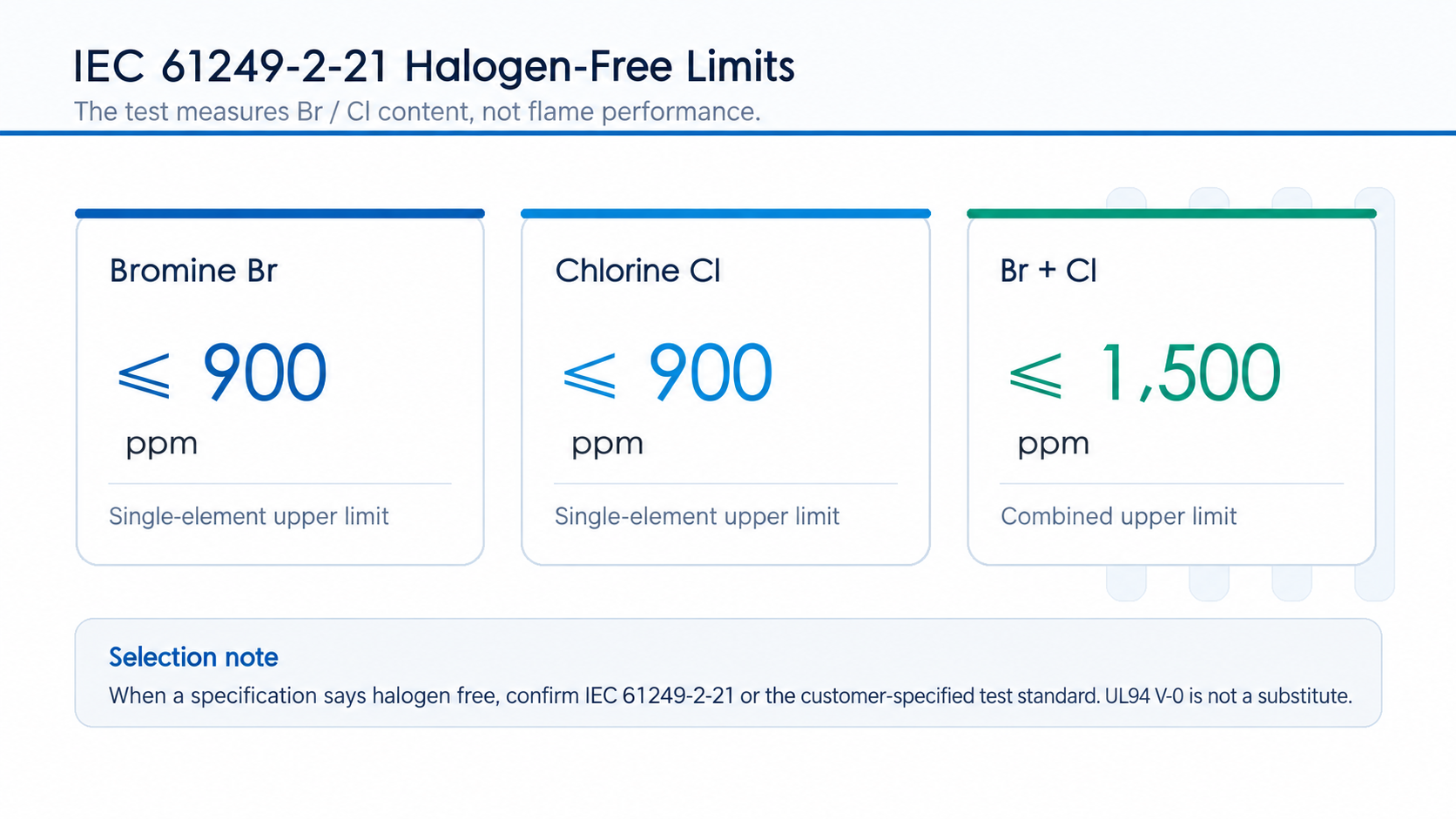
IEC 61249-2-21 sets separate limits for bromine, chlorine and their combined content.
|
Test item |
Limit |
Explanation |
|
Bromine (Br) |
Not more than 900 ppm |
Upper limit for this single element |
|
Chlorine (Cl) |
Not more than 900 ppm |
Upper limit for this single element |
|
Bromine and chlorine combined |
Not more than 1,500 ppm |
The total of both elements must not exceed this value |
One ppm is one part per million. In other words, the standard does not require the complete absence of halogens. It requires the residual content to be reduced to a very low level. It is worth explaining this point to customers early, so that a trace measurement of halogens later does not turn into a dispute.
3. The most common misunderstanding: halogen-free is not the same as flame retardant
This is the easiest mistake to make during selection. Low smoke zero halogen (LSZH) and flame retardance are two related but separate concepts. A halogen-free material is not automatically flame retardant or low smoke, and a UL94 V-0 material may well use a halogen-based formulation. The two properties must be confirmed separately.
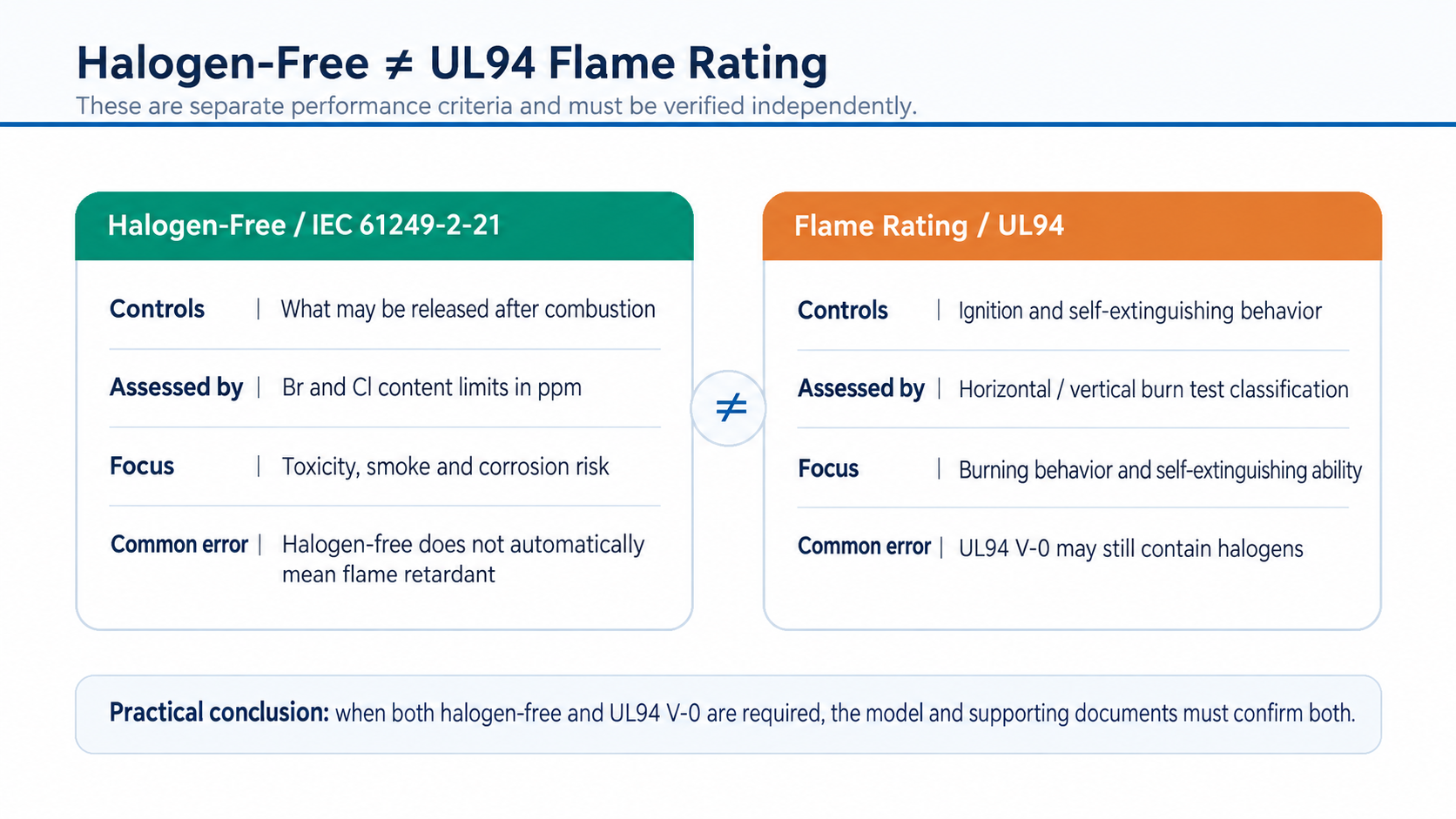
Halogen-free content and UL94 flame performance are separate requirements.
|
Comparison |
Halogen-free (IEC 61249-2-21) |
Flame rating (UL94) |
|
What it controls |
What the material releases when it burns |
Whether it ignites, and whether it self-extinguishes |
|
How it is assessed |
ppm limits on bromine and chlorine content |
Horizontal and vertical burn tests, graded HB, V2, V1, V0 |
|
Where it appears in the catalog |
Marked with the halogen-free environmental symbol |
Flame rating symbol system (catalog P.254) |
|
Can one replace the other |
No |
No |
The conclusion is simple. If a customer specification calls for both halogen-free material and UL94 V-0, the part number must carry both marks. If either one is missing, the part does not meet the specification.
4. Three examples from the KSS catalog
The following three items in the current KSS catalog correspond directly to halogen-free requirements at the material level.
|
Product |
KSS part number |
Key specifications |
Catalog page |
|
Halogen-free insulating wiring duct |
MHF-4040 (series 0102) |
Width x height 40 x 40 mm, 8 mm cable exit slots, UL-recognized white PC/ABS, UL94 V-0, rated to 100 degrees Celsius, supplied in 2 m lengths including base and cover. It carries both the halogen-free environmental mark and the 94V-0 flame rating. This is currently the only size in the catalog. |
P.24 |
|
Halogen-free heat shrink tubing |
NHR2 series (NHR2-1 to NHR2-18) |
Halogen-free cross-linked PE compound; continuous operating temperature from minus 55 to 125 degrees Celsius; shrink ratio 2:1; flame rating VW-1; UL file E48762. |
P.182 |
|
Stainless steel cable ties |
BST / BCT series (series 0370) |
Made of 316 or 304 stainless steel, so the material itself contains no halogens. Lengths from 127 to 838 mm (5 to 33 inches), widths 4.6 and 7.9 mm, tensile strength 100 to 250 lbs. Quick-lock design suitable for outdoor, humid, high-temperature and cold environments. UL file E97527. |
P.97 |
MHF-4040 is the clearest example of a part that satisfies both requirements at once. The halogen-free mark and the 94V-0 flame rating appear together on the same part number, so there is no need to cross-check two separate documents during selection.
5. Selection guidance: first confirm which requirement the specification means
• Step one: confirm exactly which requirement the customer means. Halogen-free to IEC 61249-2-21, low smoke zero halogen (LSZH), and UL94 V-0 flame retardance are frequently used interchangeably, but each one requires a different test document.
• Step two: check the catalog marks for each individual part number. Do not draw conclusions from the series name, because different part numbers within one series can use different materials and carry different ratings.
• Step three: if the specification calls for halogen-free cable ties, confirm the part number with our sales team first. CV series cable ties in the current KSS catalog (P.64-71) are classified mainly by the 94V-2 and 94V-0 flame ratings, and no individual part number specifically marked as halogen-free certified has been identified. If a customer explicitly requires halogen-free certified cable ties, please confirm the latest part numbers with our sales team to avoid an incorrect quotation. BST / BCT stainless steel cable ties are an alternative worth considering, since the metal itself contains no halogens.
Please note: certification coverage varies by specific model and SKU. For a formal project, please confirm the applicable part numbers and certificates with our sales team.
Contact
For specification sheets, certification documents or the complete part number list for the KSS halogen-free range, please contact us.
Jwo Yiih Enterprise CO., LTD.
Contact us at sales@jwoyiih.com or call +886-4-8760280 for the full solution package and part number list.
Note: all limit values, part numbers, specifications and catalog pages cited in this article are taken from the KSS factory master catalog and from previously verified industry solution documents (AI servers and data centers, offshore wind power, industrial control panels, rail transit). Certification coverage varies by specific model and SKU; for a formal project, please confirm the applicable part numbers and certificates with our sales team. For a formal quotation, please confirm current part numbers and the latest specification documents with our sales team.