
Bridas para cables frente a cintas de gancho y bucle: cómo elegir la solución adecuada de gestión de cables para racks de centros de datos
Bridas para cables frente a cintas de gancho y bucle: cómo elegir la solución adecuada de gestión de cables para racks de centros de datos
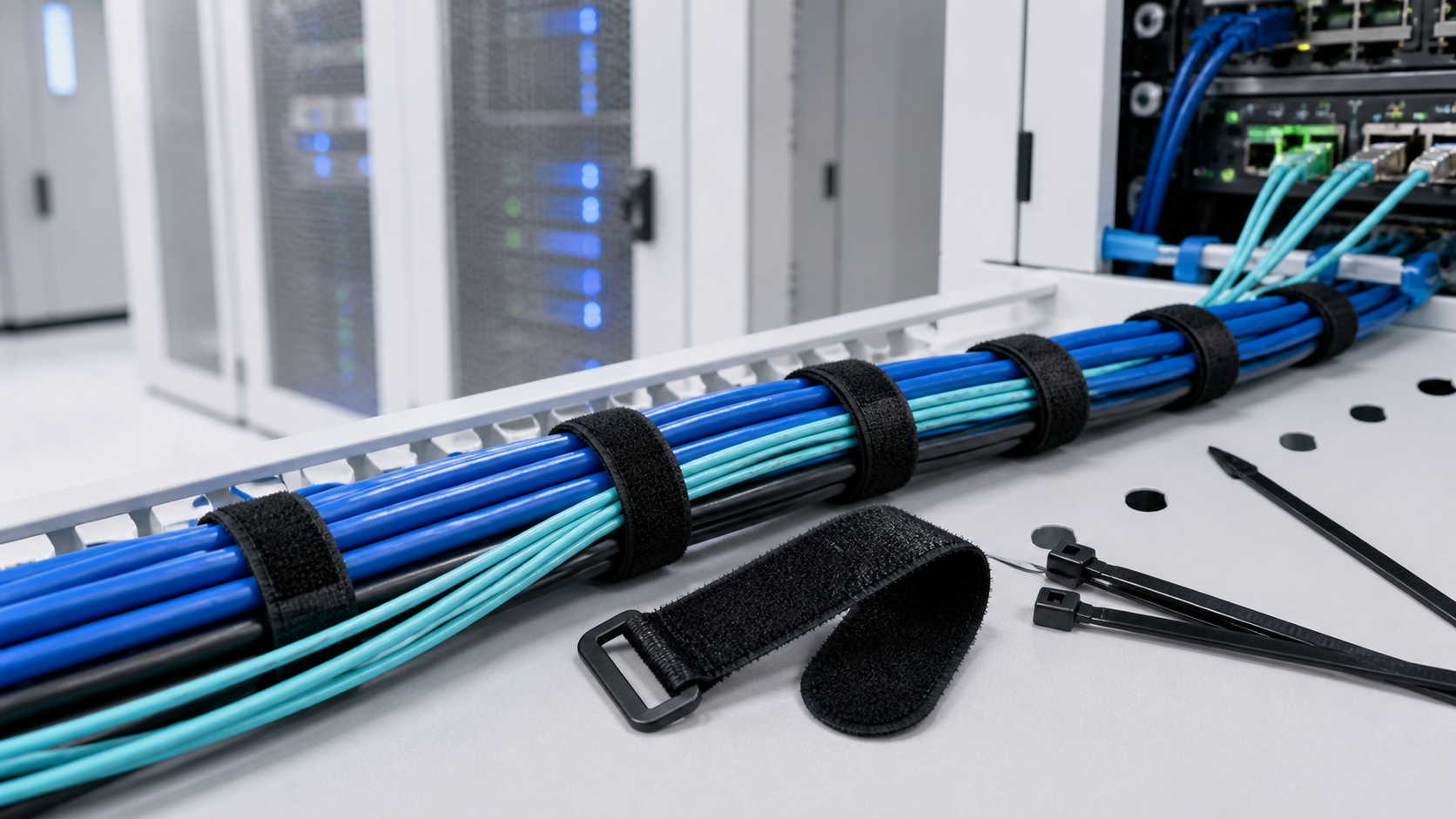
El cableado de los racks de centros de datos se beneficia de métodos de fijación que pueden reajustarse.
Tres meses después de la puesta en servicio de una sala de datos, un ingeniero regresa al mismo rack. Esta vez, el trabajo consiste en añadir dos switches y retirar seis cables de conexión antiguos. Ahora es necesario cortar, uno por uno, todos los bridas de nylon instalados durante el montaje original y volver a sujetar el haz. Si el cortador se desvía, puede dañar un latiguillo de fibra óptica situado junto a la brida. Los racks de servidores de IA ya transportan muchos más cables que los racks tradicionales, a menudo varios cientos por rack, y se recablean con frecuencia. En este entorno, un elemento de fijación que solo se bloquea una vez se convierte gradualmente en un coste de mantenimiento. Este artículo explica la diferencia entre las bridas para cables y las cintas de gancho y bucle, los números de pieza KSS correspondientes y las situaciones para las que está diseñado cada producto.
1. Dos principios de fijación diferentes
Una brida de nylon es un elemento de fijación con bloqueo. La cinta dentada encaja en un trinquete y se bloquea en una sola dirección. La tensión depende de la fuerza con la que tire el instalador y, para retirarla, es necesario cortarla. Es un consumible de un solo uso. Una cinta de gancho y bucle funciona de forma diferente. La superficie de ganchos y la superficie de bucles se unen, y la cinta pasa por una hebilla y se pliega sobre sí misma. Puede abrirse en cualquier momento, volver a tensarse y reutilizarse.
El catálogo de KSS incluye ambas soluciones. Para agrupar y organizar cables a lo largo de las filas de racks, se aplican las bridas de nylon de la serie CV (serie 0301, NYLON 66 reconocida por UL, clasificación de llama 94V-2, longitud de 63.7 a 1,500 mm, anchura de 2.5 a 9.0 mm, resistencia a la tracción de 7 a 462 lbs / 3 a 210 kgs, catálogo P.64-65). Para cables de red y de señal dentro del rack, se aplican las cintas de gancho y bucle MGL y MTL (series 0351 / 0352, catálogo P.93). No se trata de decidir qué producto es mejor. Cada uno resuelve una necesidad de fijación diferente.
2. Por qué los cables de red y de fibra no deben agruparse con demasiada tensión
Los cables de red de alta velocidad (UTP y STP) y los latiguillos de fibra óptica son mucho más sensibles a la presión externa que los cables de alimentación estándar. Una brida de nylon aplica presión sobre una zona de contacto estrecha. Si el haz se aprieta demasiado, la cubierta del cable y su estructura interna pueden deformarse, lo que afecta a la calidad de transmisión. En campo, la tensión suele evaluarse manualmente, por lo que resulta difícil estandarizarla.
El catálogo de KSS describe claramente las series MGL y MTL: están diseñadas para agrupar cables de red, cables de señal y cables de alimentación, y son reutilizables. La apertura repetida y la tensión ajustable responden a dos constantes de un centro de datos. En primer lugar, los cables no deben comprimirse demasiado. En segundo lugar, el cableado cambia continuamente.
ANSI/TIA-942-C también ha elevado a 800 mm la anchura mínima del rack para las áreas de distribución principal, intermedia y horizontal, mientras que los conectores VSFF impulsan la densidad de fibra hacia aplicaciones de 400G y 1.6T (16 fibras). El número de cables en un solo rack es ahora muy superior al de un rack tradicional. Cuantos más cables haya, más densos sean y con mayor frecuencia cambien, mayor será el valor de un elemento de fijación reutilizable. (Fuente de los datos de tendencia: material técnico de ANSI/TIA-942-C disponible públicamente.)
3. MGL frente a MTL: hebilla de plástico o hebilla metálica
KSS ofrece dos series de cintas de gancho y bucle. Las principales diferencias son el material de la hebilla y el rango de tamaños:
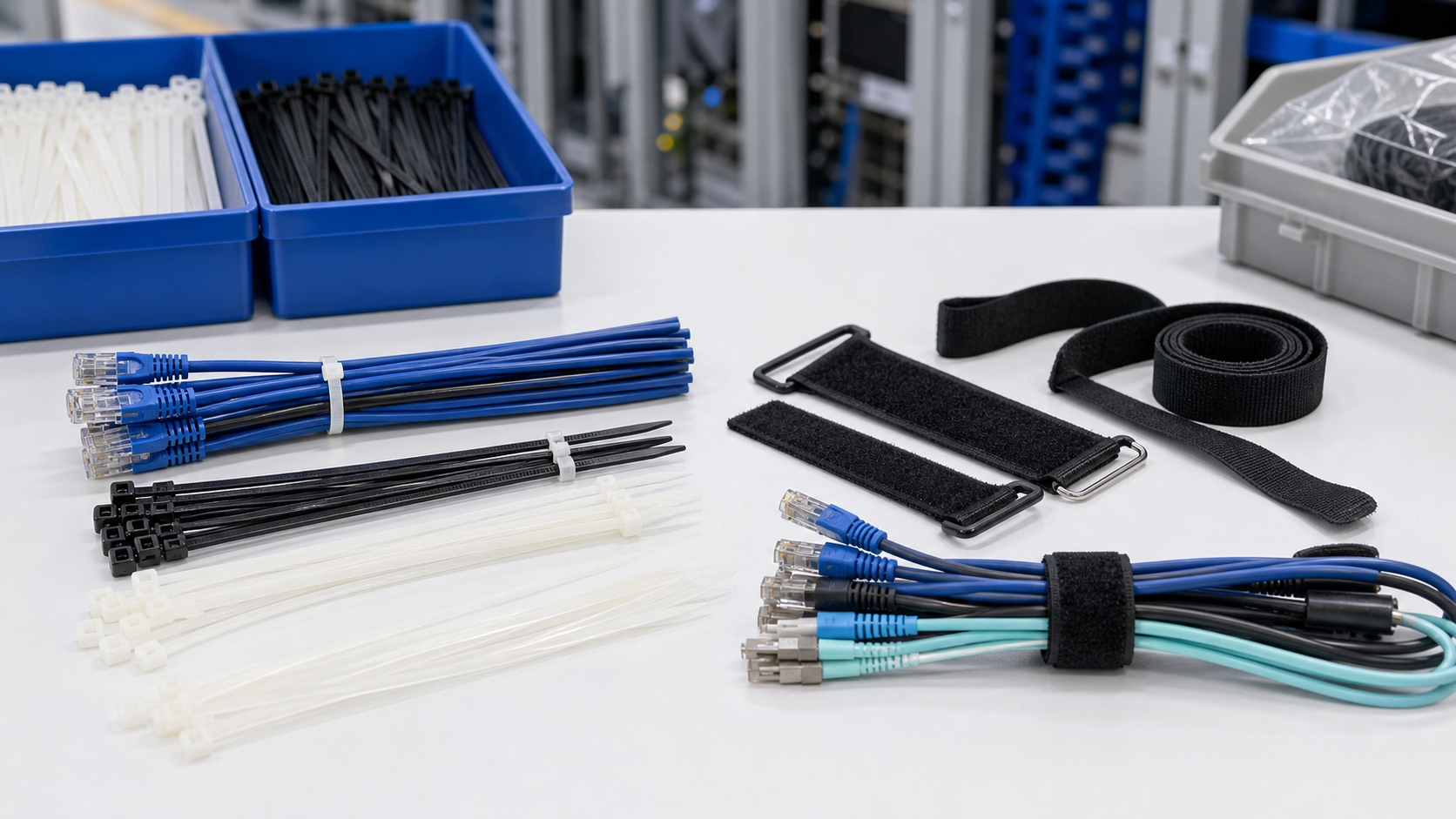
Las bridas de nylon y las cintas de gancho y bucle responden a necesidades de fijación diferentes.
|
Producto |
Serie MGL (0351) |
Serie MTL (0352) |
|
Números de pieza |
MGL-330 / 430 / 500 / 600 / 600M |
MTL-150 a MTL-700, MTL-500L |
|
Material de la hebilla |
Hebilla de plástico POM |
Hebilla de acero niquelado (alta resistencia) |
|
Material de la cinta |
Superficies de ganchos y bucles de NYLON |
Superficies de ganchos y bucles de NYLON |
|
Longitud |
340 a 596 mm (13.5 a 23.625 in.) |
153 a 702 mm (6 a 27.5625 in.) |
|
Anchura |
15 a 90 mm |
9 a 11.8 mm |
|
Color / embalaje |
Negro / 10 uds. |
Negro / 10 uds. |
|
Aplicación |
Agrupación de cables de red, señal y alimentación; reutilizable |
Igual que MGL; la hebilla metálica ofrece mayor resistencia para agrupaciones de alta exigencia |
|
Página del catálogo |
P.93 |
P.93 |
La regla de selección es sencilla. Elija MGL cuando una sola cinta deba sujetar un haz más ancho o grueso, ya que la anchura de la cinta alcanza 90 mm. Elija MTL cuando el haz sea más estrecho pero la hebilla deba ser más resistente, o cuando se necesite una longitud mayor (hasta 702 mm) o menor (desde 153 mm).
4. Cuándo una brida sigue siendo la opción correcta
Las cintas de gancho y bucle no sustituyen a las bridas para cables. En las siguientes situaciones, las bridas, los canales o las abrazaderas siguen siendo la solución correcta:
|
Aplicación |
Producto recomendado |
Especificaciones principales |
Página del catálogo |
|
Agrupación de haces de cables a lo largo de las filas de racks |
Bridas de nylon de las series CV / CVT |
NYLON 66 reconocido por UL / 94V-2, resistencia a la tracción de 7 a 462 lbs (3 a 210 kgs) |
P.64-65 |
|
Compartimentos cortafuegos que requieren 94V-0 |
Bridas de nylon ignífugas CV-V0 |
NYLON 66 reconocido por UL / 94V-0, longitud de 100 a 380 mm, resistencia a la tracción de 18 a 120 lbs |
P.69 |
|
Grupos electrógenos exteriores y zonas con equipos de refrigeración |
Bridas resistentes a los rayos UV y a la intemperie CV-N612 |
NYLON 612 reconocido por UL / HB, resistente a los rayos UV y a la corrosión, longitud de 100 a 370 mm |
P.68 |
|
Tendido y fijación de cables dentro del rack |
Canaleta de cableado sin halógenos MHF, abrazaderas de cables UC / PC / KUC |
MHF-4040: PC/ABS blanco, UL94 V-0, temperatura nominal de 100 grados C, orificios de salida de 8 mm |
P.24 / P.106 |
En una frase: utilice bridas cuando necesite un bloqueo permanente y deba documentarse una clasificación de resistencia al fuego o a la intemperie; utilice cintas de gancho y bucle cuando el haz se abra con frecuencia y los cables no deban comprimirse. En la práctica, ambas soluciones se utilizan dentro del mismo rack. No se trata de una decisión excluyente.
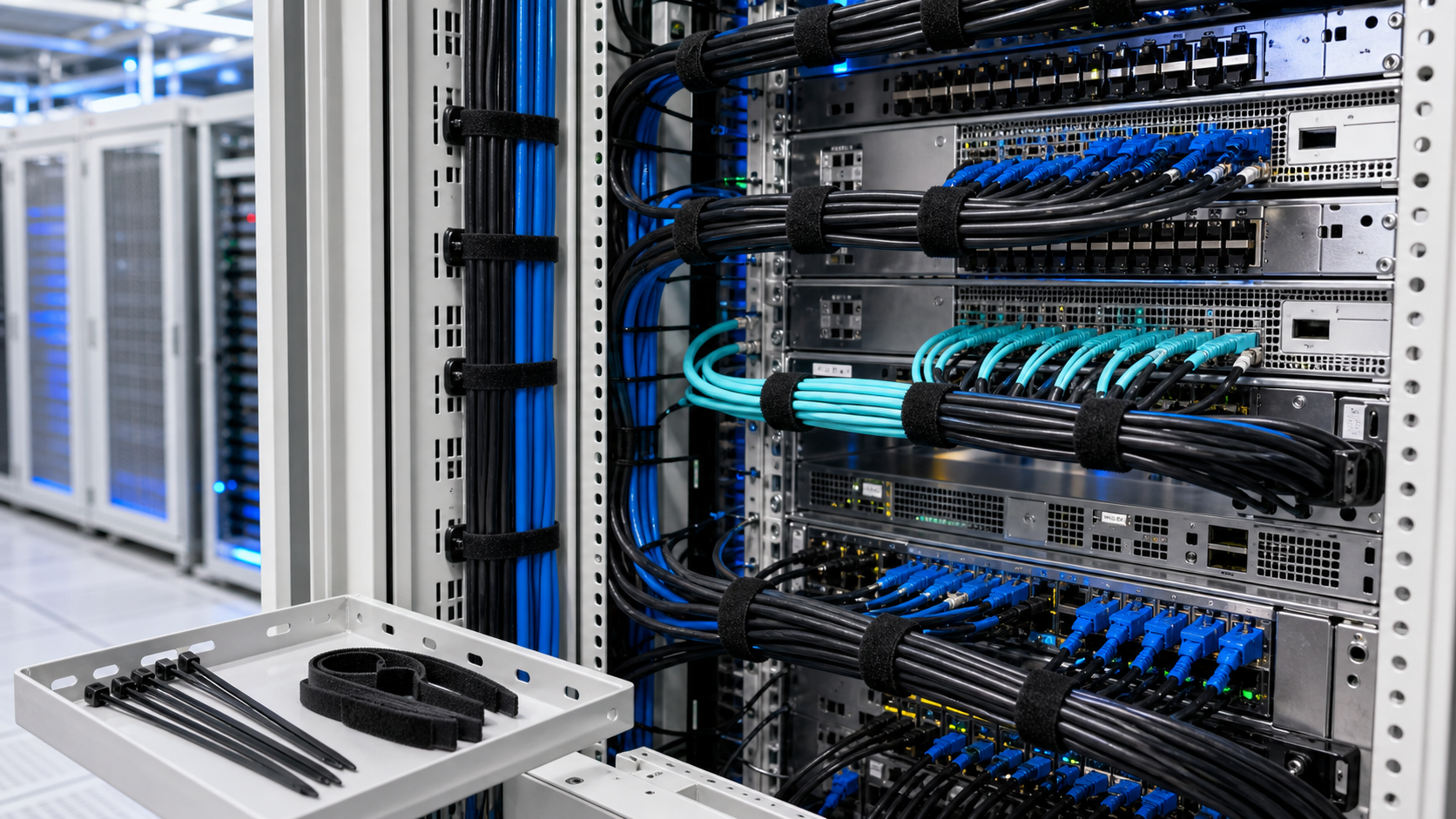
Las bridas y las cintas de gancho y bucle suelen trabajar conjuntamente dentro de un rack.
5. Tres errores habituales de selección
Error 1: suponer que las cintas de gancho y bucle pueden sustituir a todas las bridas. La reutilización es una ventaja, pero también significa que la cinta no constituye un bloqueo permanente. En los puntos de fijación que requieran una clasificación de resistencia al fuego (94V-2 o 94V-0), resistencia a la intemperie o una resistencia a la tracción documentada, deben seguir utilizándose bridas de la serie CV. El catálogo KSS actual indica el material, las dimensiones y la aplicación de las series MGL y MTL, pero no especifica una clasificación de resistencia al fuego ni un valor de resistencia a la tracción. Si las especificaciones de un proyecto requieren una clasificación de resistencia al fuego o un valor de resistencia mecánica para las cintas de gancho y bucle, confirme primero este aspecto con nuestro equipo comercial.
Error 2: suponer que un haz más apretado es un haz más seguro. Esto puede ser válido para los cables de alimentación, pero ocurre lo contrario con los cables de red de alta velocidad y la fibra óptica. Estos cables deben agruparse con una tensión moderada y cierta holgura, exactamente lo que proporciona la tensión ajustable de una cinta de gancho y bucle.
Error 3: suponer que todas las piezas de una serie comparten las mismas especificaciones. MGL y MTL son cintas de gancho y bucle, pero el material de la hebilla y los rangos de anchura y longitud difieren considerablemente (MGL de 15 a 90 mm de anchura, MTL de 9 a 11.8 mm de anchura). Dentro de la serie CV, el rango es aún mayor: de 63.7 a 1,500 mm de longitud y de 7 a 462 lbs de resistencia a la tracción. Verifique siempre las especificaciones número de pieza por número de pieza, en lugar de hacerlo únicamente por el nombre de la serie.
Nota importante: la cobertura de las certificaciones varía según el número de pieza y la SKU específicos. Confirme con nuestro equipo comercial los números de pieza aplicables y los certificados vigentes para cada proyecto.
Acerca de KSS: una única fuente de suministro para toda la gestión del cableado
KSS se fundó en 1969 y es un líder mundial en accesorios de cableado. Sus productos se venden en 128 países y prestan servicio a más de 40,000 clientes, lo que convierte a KSS en uno de los mayores fabricantes de bridas y accesorios de cableado de Asia. El parque de investigación y fabricación de KSS ocupa 500,000 metros cuadrados, la producción diaria de bridas alcanza los 50,000,000 de unidades y el sistema de almacén totalmente automatizado tiene capacidad equivalente a más de 1,000 contenedores de veinte pies. Para un proyecto de centro de datos, la ventaja práctica es directa: las cintas de gancho y bucle, las bridas, las canaletas de cableado, las abrazaderas, los marcadores de cables y los terminales pueden obtenerse de una sola marca, con datos de especificaciones y estándares de calidad uniformes, lo que también facilita establecer una fuente secundaria de suministro estable.
Contacto
Para obtener las especificaciones completas y los precios de las cintas de gancho y bucle MGL y MTL de KSS, las bridas de la serie CV o la gama completa de soluciones de gestión de cables para centros de datos, póngase en contacto con nosotros:
Jwo Yiih Enterprise CO., LTD.
Escríbanos a sales@jwoyiih.com o llame al +886-4-8760280 para obtener el paquete completo de soluciones y la lista de números de pieza.
Nota: todos los números de pieza, las especificaciones y los números de página del catálogo incluidos en este artículo se han extraído del catálogo maestro oficial de KSS y se han verificado pieza por pieza (los números de página corresponden a la paginación del catálogo impreso). Los datos de tendencia sobre la anchura de los racks, la densidad de fibra y el número de cables proceden de material técnico de ANSI/TIA-942-C disponible públicamente. La cobertura de las certificaciones varía según el número de pieza y la SKU específicos. Para obtener una oferta formal, confirme con nuestro equipo comercial los números de pieza actuales y los certificados válidos.